How to Plan an Electric Gate System From Scratch
A good gate job is mostly good planning. Get the plan right and the fitting is the easy part.
This guide gives you a logical order to work through when planning an electric gate system. The order matters because each decision helps narrow down the next: the site influences the gate type, the gate type and size influence the motor, and how the gate will be used influences the power and access-control options.
If you're an electrician moving into gate automation, the planning side may be the unfamiliar part, but the process is straightforward once you know what to look for. If you're a homeowner planning a project before speaking to an installer, the same steps will help you understand what's involved and ask the right questions.
The aim is simple: make the important decisions on paper, not halfway through the installation.
Start with a Site Survey
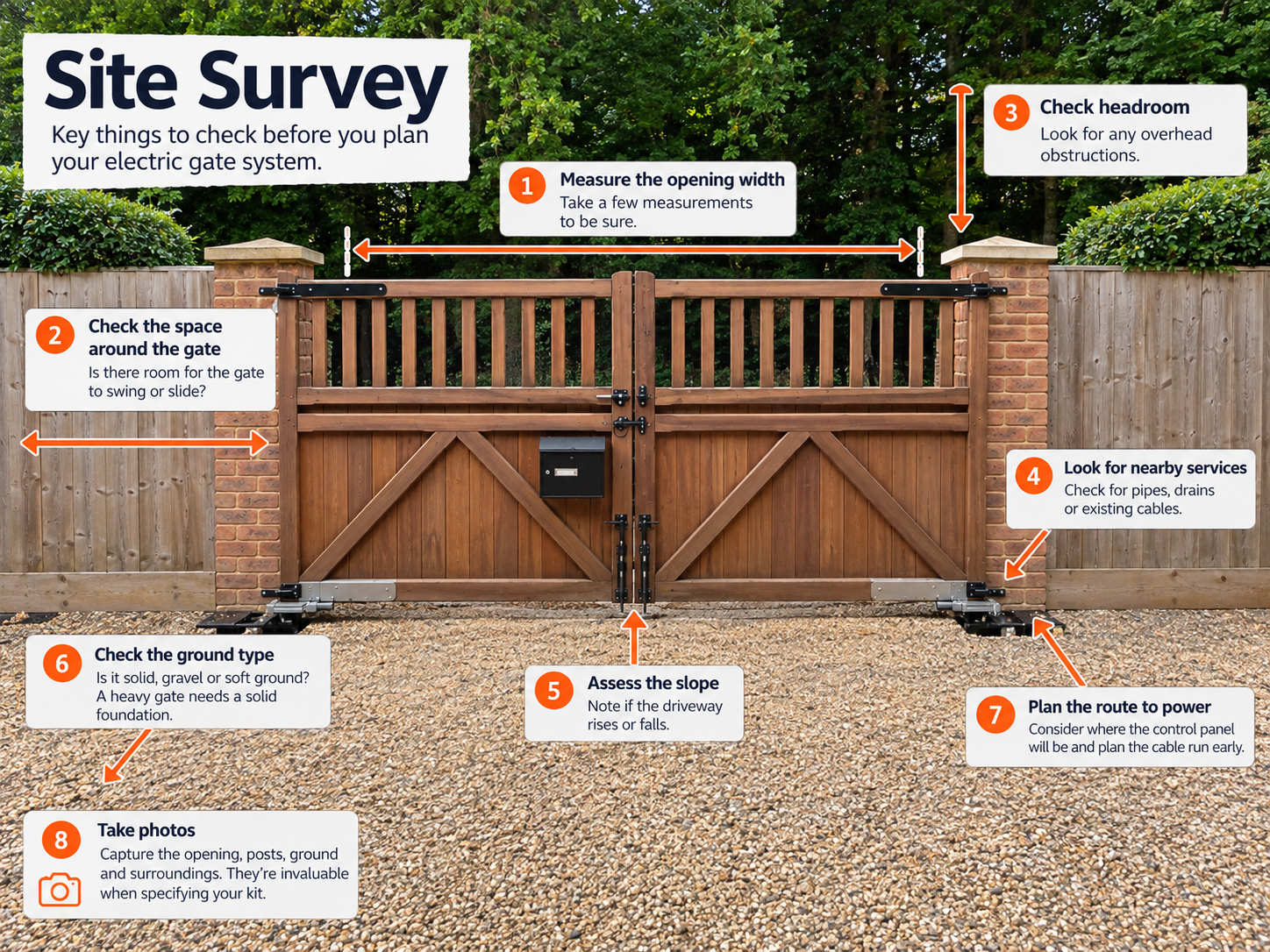
Before you buy anything, look carefully at the site. The ground, available space and surrounding area can determine which type of gate and automation will work.
Check the slope. A driveway that rises or falls can affect which gate type is suitable. A swing gate, for example, cannot simply open uphill into rising ground.
Look at the space around the opening too. A sliding gate needs enough room to move sideways beyond the opening, while a swing gate needs a clear area through its entire opening arc.
The surface matters as well. Soft ground, gravel and slopes can all affect how the gate and automation are supported. A heavy gate needs a solid foundation, so made-up or unstable ground may require additional groundwork.
Measure the opening width and take more than one measurement. Note any restricted headroom and consider what may already be underground, such as drains, water pipes or electrical cables. Finding these before work starts is considerably easier than finding them with a spade.
Take plenty of photographs too. Get clear pictures of the opening, posts, ground on either side and the proposed route back to the power supply. If the ground rises or falls noticeably, record that as well.
Choose the Gate Type: Sliding or Swing
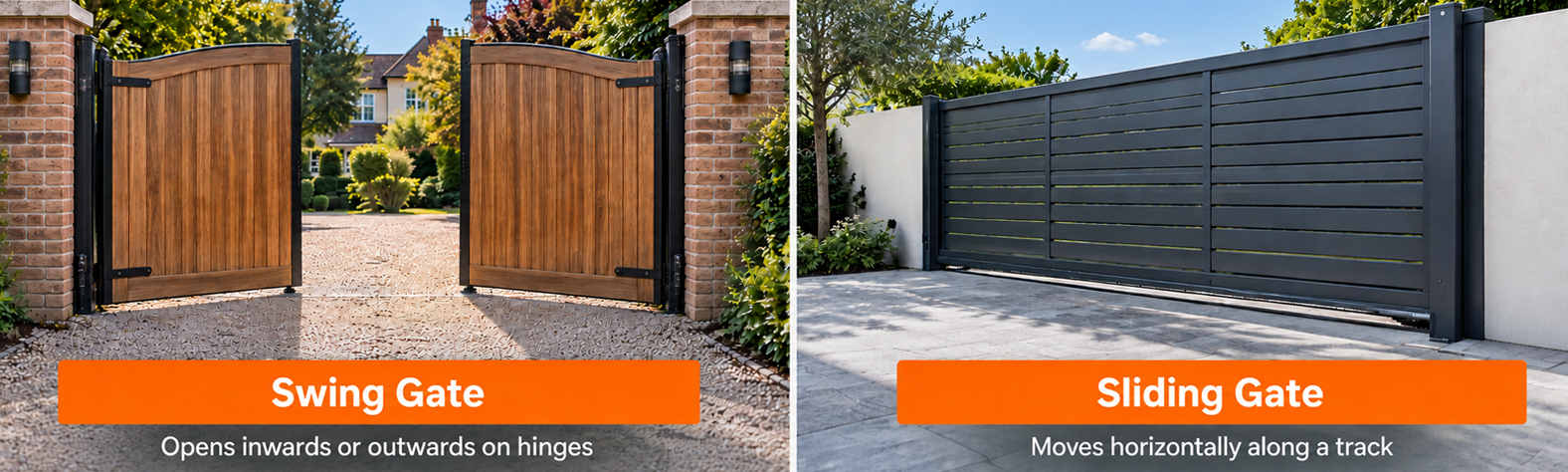
This is usually the first big decision.
A swing gate operates on hinges like a conventional door. It generally suits openings with sufficient space for the gate to swing and reasonably level ground.
A sliding gate travels sideways across the opening. It can be particularly useful where driveway space is limited, the ground makes a swing gate impractical, or you don't want the gate sweeping across an area used by vehicles or pedestrians. Sliding gates do, however, need somewhere to go. You'll need sufficient run-back space beside the opening for the gate to move into
If you're unsure which option suits your site, our sliding gate buying guide and swing gate buying guide explain the differences in more detail.
Know the Weight and the Width
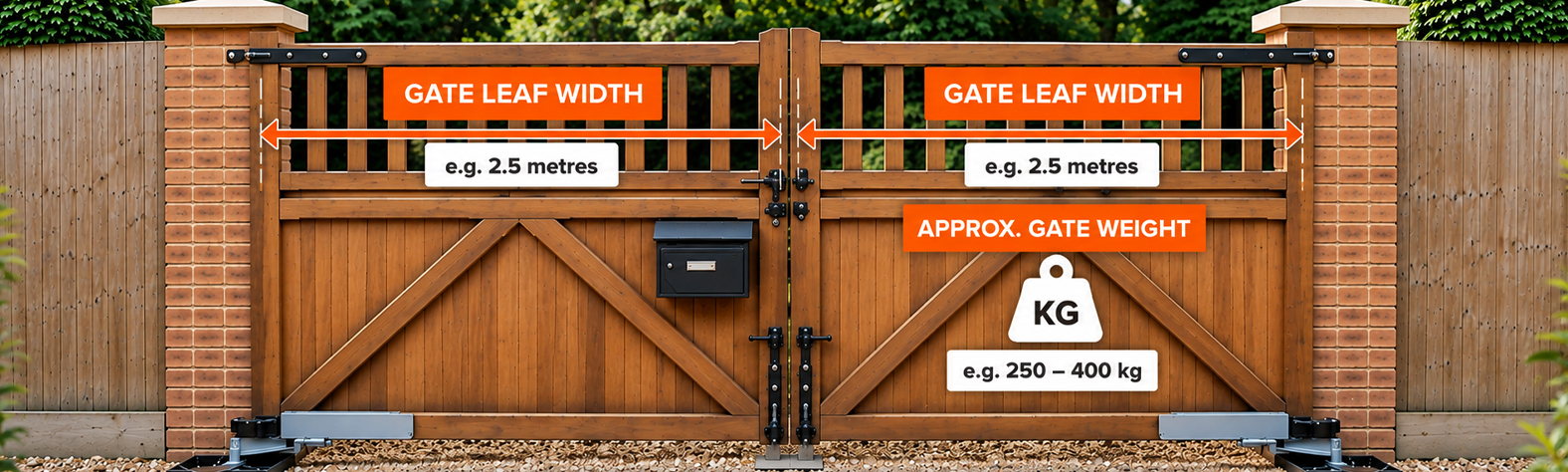
Motors are matched to the gate, so you need some real numbers before choosing one.
Two measurements are particularly important: the weight of the gate and the width of the gate or individual gate leaf.
A motor suitable for a relatively light timber gate may not be suitable for a much heavier steel gate of a similar size.
If you don't know the weight, try our gate weight estimator. Use the dimensions and material to get an approximate weight that you can use when comparing automation. That estimate is usually all you need to choose a motor with confidence, and it saves the guesswork that leads to an underpowered kit.
Avoid choosing a motor that will constantly operate at the limit of its rating. Allowing some headroom can help ensure the automation is appropriately matched to the gate.
Think About How Often it Will Be Used
Gate size isn't the only consideration. Think about how often the automation is likely to operate.
A gate serving a family home with a couple of vehicles has very different demands from one serving a shared driveway, workplace or busy entrance.
This is one of the considerations when comparing 24v and 230v automation.
Don't base your decision on the quietest day. Think about the busiest realistic day and how many times the gate is likely to open and close.
| 24v | 230v |
| Better suited to frequent operation | Suitable for less frequent operation |
| Battery backup options | Often simpler/lower cost |
| Common choice for higher-use gates | Common choice for lighter domestic use |
Sort Out the Power Supply
A gate motor needs an appropriate electrical supply, so plan this early rather than treating it as something to work out once the gate is installed.
Consider the cable route from the supply to the automation and where the control equipment will be positioned.
This is also the time to consider what should happen during a power cut. If maintaining access during an outage is important, look at systems that support battery backup.
Plan the cable routes for your safety equipment and access control at the same time. Photocells, keypads, intercoms and other accessories may all require connections back to the control equipment.
It's much easier to plan the necessary ducts and cable routes before the driveway is finished than to dig it up again later.
Even a simple sketch showing where each component will be positioned can make the installation much easier.
Plan Access Control and Safety Together
Once the gate moves, there are two more questions to answer:
Who needs to open it, how will they open it, and how will the system operate safely?
It's worth considering these together because both can affect the control equipment and cable routes.
For access, common options include:
- Remotes & Keyfobs
- Keypads
- Key Switches
- Audio Intercoms
- Video Intercoms
- GSM/mobile-based access systems
Think about how people will actually use the entrance.
A delivery driver arrives while you're inside the house. Would being able to see and speak to them through a video intercom be useful?
Someone regularly needs access without carrying a handset. Would a keypad be easier?
Family members simply need to open the gate from their cars. Remote handsets may be all that's required.
Thinking through these everyday situations helps you choose the access control you actually need rather than adding equipment simply because it's available.
Browse our intercom systems and access control to see the different options.
Safety should be planned at the same stage.
Depending on the gate design, installation and risk assessment, appropriate safety measures may include photocells, safety edges and other protective devices.
Photocells use an infrared beam to detect an obstruction across the opening. Safety edges are pressure-sensitive devices fitted to relevant areas of the gate and can trigger the automation when contact is detected.
The safety requirements aren't identical for every installation, so the appropriate protective measures should be considered as part of the design and risk assessment rather than added as an afterthought.
Browse our safety devices range for photocells, safety edges and associated equipment.



Common Questions About Planning an Electric Gate
Should I choose a sliding or swing gate?
Start with the site. Available space, ground levels and run-back room will usually narrow down the options quickly.
How do I choose a motor if I don't know the gate weight?
Use our gate weight estimator to get an approximate figure based on the gate's dimensions and construction, then compare this with the manufacturer's motor specifications.
Do automated gates need safety devices?
A powered gate needs appropriate safety measures. Exactly which devices and protective measures are required will depend on the gate, its environment and the risks identified for that particular installation.
What's the difference between 24v and 230v automation?
Broadly, 24v systems are commonly chosen where more frequent operation or battery backup is required, while 230v systems can suit less frequent applications. Always check the individual motor specifications and requirements of the installation.
Ready to Plan Your Gate Automation?
If you've worked through the steps above but aren't sure which motor, safety devices or access control will suit your project, speak to the GateMotors team.
Having a few details ready will help us point you in the right direction:
- Gate type - swing or sliding
- Opening and gate dimensions
- Approximate gate weight
- Gate material
- Expected level of use
- A few photographs of the entrance and surrounding area
From there, we can help you narrow down the options and find suitable equipment for your project.
Related Products and Guides
- Gate weight estimator — estimate your gate weight before choosing a motor
- Swing gate buying guide — help choosing swing gate automation
- Sliding gate buying guide — help choosing and sizing sliding gate automation
- Double swing gate kits — complete automation kits for double swing gates
- Sliding gate kits — complete sliding gate automation kits
- Safety devices — photocells, safety edges and associated equipment